
 Go back
 Riga Circus School Hosts a Professional Development Laboratory on Social Circus and Inclusive Circus Education
Published: 17.08.2026.
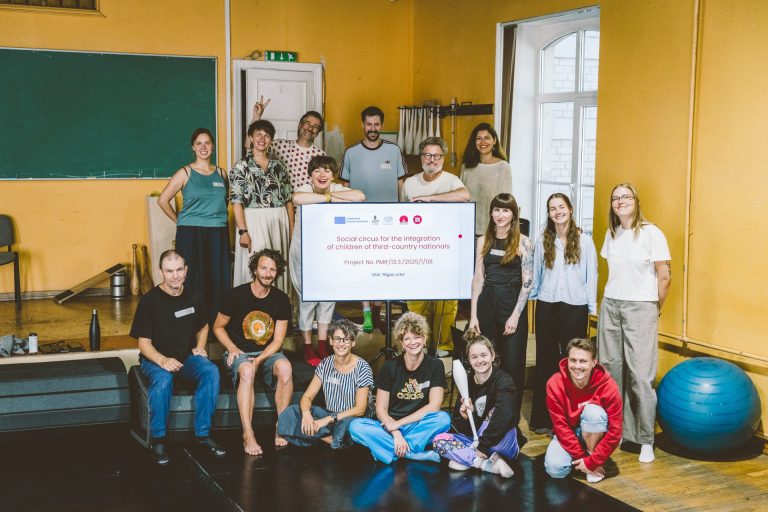
Riga Circus School teachers and the project team took part in a professional development laboratory in August 2026, before the start of the new school year, to explore the principles of inclusive circus education together with Latvian and international social circus experts and to develop a shared methodology for working with diverse groups of children.
The laboratory is part of the Riga Circus project “Social Circus for the Integration of Third-Country National Children”, which aims to promote the inclusion of children and their families in Latvian society through social circus practices. During the project, 25 children aged 7 to 14 whose families have come to Latvia from countries outside the European Union will join Riga Circus School classes and take part in a long-term creative process together with their peers, circus teachers and professional artists.
How can we create an environment where everyone can participate?
The professional development laboratory focused on how to create a safe and inclusive environment in circus classes, where differences in children’s experiences, languages and cultural backgrounds do not become barriers to participation.
Over several days, theoretical discussions alternated with movement sessions, practical exercises, group work and the exchange of experiences. Participants explored social circus theory and research, inclusive movement practices, approaches to working with diverse groups of children and young people, trauma-informed practices, as well as ways of combining circus, movement and storytelling.
In a session led by choreographer, dance artist and educator Alise Putniņa, participants explored inclusive movement practices through improvisation, partner work and shared movement, while experimenting with different ways of building collaboration within a group.
Researcher and lecturer at the Latvian Academy of Culture Signe Bahšteina introduced participants to the theoretical framework and history of social circus, as well as research into the potential of circus to foster social inclusion and personal growth. Social circus focuses not only on acquiring technical skills, but also on individual experience, participation, self-confidence and relationships with others.
International experience in working with diverse communities
An important part of the laboratory was learning from the experience of international social circus organisations.
Leander Vanhaeren shared the experience of the Belgian organisation “Circus Zonder Handen”, discussing social inclusion from both a circus trainer’s and an organisational perspective. His involvement with the organisation began 17 years ago as a participant, before he went on to become an assistant, trainer and staff member. His experience allowed the laboratory participants to examine not only specific teaching methods, but also how the principles of accessibility and inclusion can become part of an organisation’s everyday work.
Arno Wauters from the Belgian circus organisation “Ell Circo D’ell Fuego” focused on trauma-informed approaches in circus education. Participants learned about stress responses, the concept of the “Window of Tolerance” and the “Regulate, Relate, Reason” approach — first helping a person regulate their state, then building a relationship, and only then moving towards understanding and learning. Practical tools for working with children and young people who need additional support were also discussed.
From circus exercises to a shared story
Practical and creative work also played an important role in the laboratory. Under the guidance of director and choreographer Daniel Gulko, the project team explored methods of group work, movement and storytelling, including working with a simple movement vocabulary and traditional Latvian stories.
Together with Daniel Gulko, the team also began discussing the project’s creative direction — the form and content of the future performance, the working process, the team’s needs and goals. This work will continue throughout the project and culminate in a collaboratively created circus performance in 2027.
In a workshop led by Māra, participants began developing a shared social circus “toolbox” — a pedagogical framework that will bring together principles, methods and practical exercises for creating safe spaces, providing non-verbal feedback, fostering collaboration and supporting participatory creation. The methodological work begun during the laboratory will continue to be developed throughout the project, incorporating experience gained in practice.
The laboratory is only the beginning of the process
The professional development laboratory prepares the Riga Circus School team for long-term work that will continue throughout the school year. The project team brings together circus teachers and professional performing artists, social circus experts, a social pedagogue, a non-formal education teacher, and a researcher specialising in intercultural relations and sociology.
Regular meetings with a social pedagogue are planned throughout the school year to monitor group dynamics, adapt the working process and, where necessary, address disagreements at an early stage. The project will also include an introductory course on gender equality and non-discrimination, helping to strengthen a safe and respectful environment for all participants.
The next significant stage will be a joint circus camp in the summer of 2027. During the camp, project participants will work more intensively on the future performance while developing their communication, trust and collaboration skills. At the conclusion of the project in September 2027, the performance created through this collaborative process will be presented to a wider audience.
The project “Social Circus for the Integration of Third-Country National Children” is being implemented from 1 April 2026 to 30 September 2027. At its core is the idea of social circus — using circus arts not only as an opportunity to learn new skills, but also as a space for meeting, collaborating, developing a sense of belonging, and allowing diverse experiences to become visible and heard.
#ESfondi, #EUFunds #EUinmyregion, #InvestEU, #ESfondiDROSIBA and #ESfondiSOLIDARITATE
Project PMIF/13.3./2025/1/08 “Social Circus for the Integration of Third-Country National Children” is co-financed by the European Union and is being implemented from 1 April 2026 to 30 September 2027. The total eligible costs of the project are EUR 99,023.39, of which EUR 74,267.54 is financed by the European Union Asylum, Migration and Integration Fund, while EUR 24,755.85 is co-financed by the state budget.