
 Go back
 PANEL DISCUSSIONS | Circus Education Conference 2026
Roots & Routes | Saknes un trajektorijas | Circus Education Conference 2026
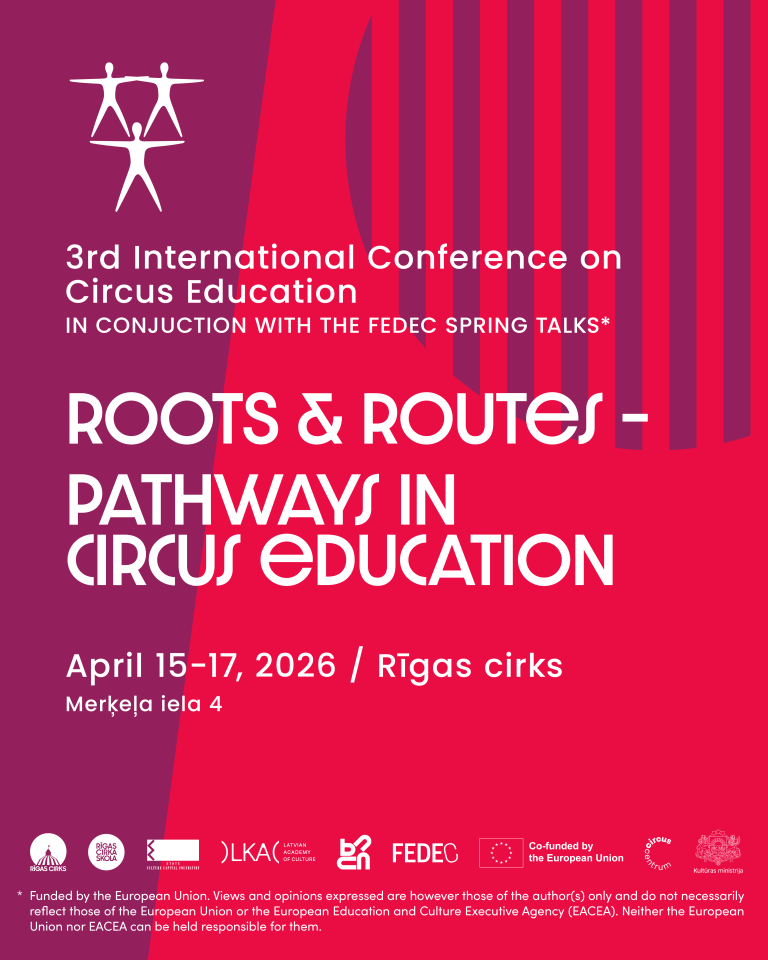
Riga Circus will host the 3rd Riga International Circus Education Conference from April 15 to 17, 2026, within the framework of the FEDEC Spring Talks of the international network for professional circus education. The conference aims to bring together a wide range of performing arts professionals from Europe and the Baltic region — including representatives of formal and non-formal education, artists, curators, producers, and policymakers in education and cultural education, including from Latvia.
The programme on April 17 is open to all interested participants.
From School to Life: Supporting Learning Across a Performing Arts Career
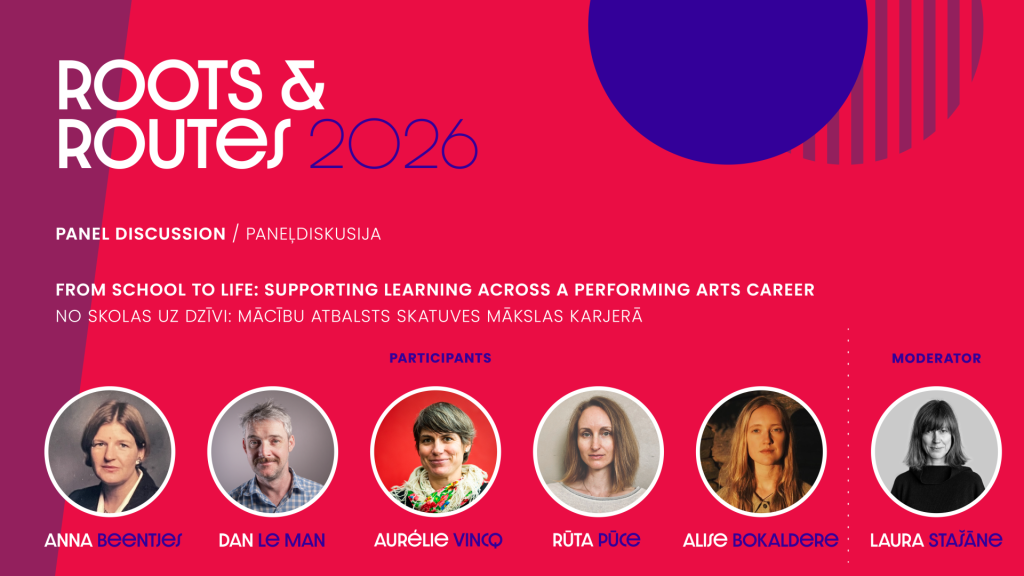
The transition from education to professional life is one of the most important stages in an artist’s career. This panel discussion looks at how artists can be supported throughout their lives — in formal education, non-formal initiatives, and in the professional field after graduation, where learning becomes a continuous process.
Anna Beentjes had worked at Codarts University for the Arts since 2000 and served as Head of the Bachelor programme in Circus Arts from 2011 till 2026. She has been on the board of FEDEC from 2016 till 2025 and was the first female president. She is also chair of the circus company Monki Business. With a background in Spanish Language and Literature, she has worked internationally as a producer across dance, theatre, and music, and previously held the position of Director for the Performing Arts at the Consulate General of the Netherlands in New York.
Dan Le Man is an Australian-born circus and physical theatre artist with over 20 years of international touring experience. Based in Estonia, he directs the Tallinn Fringe Festival and supports emerging circus artists in developing their work and careers.
Aurélie Vincq works across circus training, pedagogy, and international cooperation. Since 2009, she has been involved with Lido and Esacto’Lido, where she has developed artistic, educational, and partnership projects.
Rūta Pūce is an independent contemporary dance choreographer interested in the body as an archive and a site of research. Pūce works as a dance teacher with aspiring professional contemporary dancers at the Riga Ballet School and is actively involved in the Latvian Dance Information Centre and is the editor of the magazine “Dance.lv”.
Alise Madara Bokaldere is a Latvian dancer, choreographer, and circus artist whose work is characterised by attention to detail, nuanced movement, and a strong focus on performance presence, movement quality, and concept. She graduated from the Latvian Academy of Culture in 2018 with a BA in Contemporary Dance Art. In the Latvian Dance Awards 2023/2024, she received the Best Dancer award, while Art for Rainy Days was recognised with the Best Performance award. She was also nominated for the Latvian Dance Awards 2018/2019 and the Estonian Theatre Awards 2020.
Laura Stašāne is a dramaturge, writer, curator, and mentor working in the performing arts. Her practice is shaped by a strong interest in urban space, communities, ecology, and the ways people live together. She regards the International Festival of Contemporary Theatre Homo Novus in Riga, where she contributed for many years, as her most important professional school and a lasting source of inspiration and knowledge.
The role of education in the cultural ecosystem
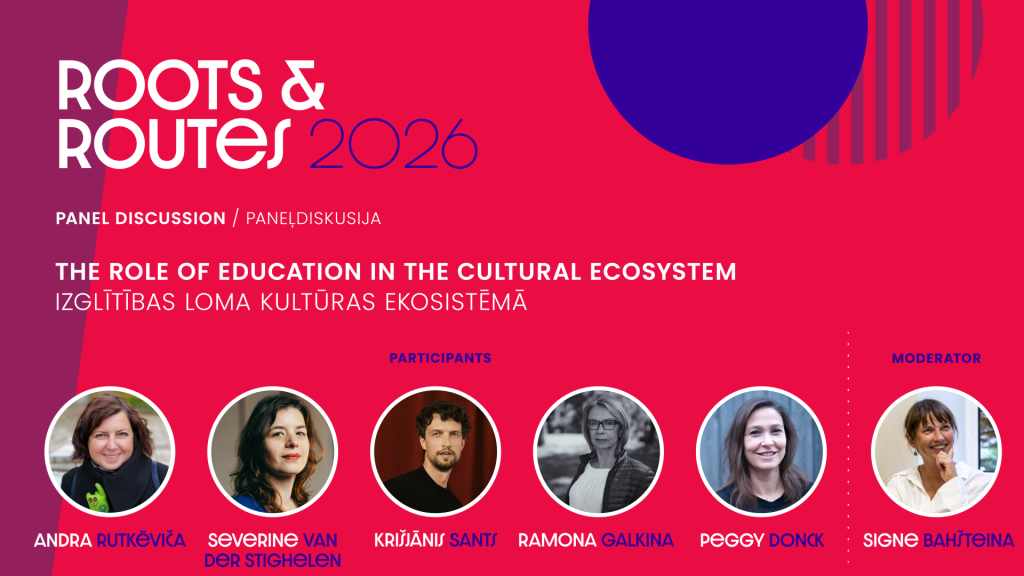
Education is a vital part of the cultural ecosystem, shaping artists, audiences, and the professionals who sustain the field. This panel discussion examines how education at different levels can support long-term sector development by nurturing talent, passing on knowledge, sustaining creative diversity, and connecting institutions to the wider cultural ecosystem.
Andra Rutkēviča works at the Ministry of Culture of Latvia as an officer in the Cultural Policy Department’s Arts Policy Division. She brings a public policy perspective on how cultural strategy and state support can strengthen the performing arts sector and its development.
Séverine Van der Stighelen works on international relations and project development at Circuscentrum, the support organisation for circus arts in Flanders. Her work focuses on international exchange, networking, and creating opportunities for the Flemish circus sector across borders, building on a long background in higher education internationalisation.
Krišjānis Sants is an internationally active choreographer, dancer, set designer, and cultural organizer whose practice operates at the intersection of contemporary dance, scenography, and immersive performance formats. His work often explores collective presence, spatial dramaturgy, and embodied forms of encounter beyond the conventional black-box setting. Since 2020 Krišjānis runs dance organisation Tuvumi, is on the board of Association of Contemporary Cultural NGOs and is a member of Latvian National Council for Culture. Alongside his artistic and organisational work, Krišjānis teaches a yearly workshop in site-sensitive scenography for dancers at the Lithuanian Academy of Music and Theatre.
Ramona Galkina is a professor at the Latvian Academy of Culture, as well as a choreographer and dancer active in contemporary dance since 1996. Alongside her academic work, she continues to create and collaborate in contemporary dance and theatre projects in Latvia and internationally.
Peggy Donck is the Director of CNAC in France since 2022, becoming the first woman to lead the institution. With a strong background in circus production and networks, she has worked with major companies such as Collectif AOC and Compagnie XY, and is committed to support emerging artists and innovation in circus education.
Signe Bahšteina is a lecturer and head of the Latvia–France Intercultural Relations study specialisation at the Latvian Academy of Culture, where she is also a PhD student. Her research focuses on contemporary circus as a transcultural ecosystem, with a wider interest in intercultural communication and the ways artistic creation, education, and management intersect.